




• Dünya
  • Ekonomi
  • Politika
  • Kültür & Sanat
  • Opinion Internatıonal
  • Gorüş TV
  • Görüş Podcast
  • Diğer
Salı, Haziran 9, 2026
  • Giriş Yap
  • Kayıt Ol
Görüş
  • Dünya
    • Tümü
    • ABD
    • Afrika
    • Asya
    • Avrupa
    • Kuzey Amerika
    • Latin Amerika
    • Orta Doğu
    sibel özbudun &temel demirer

    56. Sene-i Devriyesinde 15-16 Haziran Ve Bugün(ümüz)

    israil, Iran ve Ortadogu

    Beş Günde Çöküş: İran, İsrail Ordusu’nun İkmal Zincirini Nasıl Çökertti?

    1. Mayis 2026

    Veriler İle Ekonomi-Politik Hâl-i Pür Melâl (imiz)[*]

    ibrahim kaypakkaya

    İbo’nun ‘Ölümsüzlüğü’nün 53. Yılında Patika’nın Sorularına Yanıtlar[*]

    Rusya ve S 400ler

    Suriye’de Yeni Dönem: S-400’ler Dengeleri Değiştiriyor

    Dr. Jan Campbell

    Bir Geçit Töreninin Ardından

  • Ekonomi
    Bir Gecede 1 Trilyon Dolar Buhar Oldu: Algoritmaların Gazabı

    Bir Gecede 1 Trilyon Dolar Buhar Oldu: Algoritmaların Gazabı

    istanbul üniversitesi

    Neoliberalizm Üniversiteleri Ele Geçirdi: Öğrenciler Müşteri, Akademisyenler Taşeron

    Kredi karti bocrlanmasi

    Türkiye’de Kredi Kartlarının Krize Dönüşen Yükselişi

    Paranın İktidarı: Wall Street’in Altında Ezilen Emek

    Paranın İktidarı: Wall Street’in Altında Ezilen Emek

  • Politika
    Dr. Jan Campbell

    İnsan Haklarının Geleceği

    devlet ve millet / Hüseyin Demirtas

    Kalıcılaştırılmış KHK Rejiminin Röntgeni: AİHM Şaban Yasak Kararıyla Tescillenen Anatomi

    Sibel_özbudun

    “Aykırı Kadınlar” Tarihinden: Vilma Espín

    üc fidan

    Ölüme Giderken Rodriguez Dinlemek: Üç Fidan, Deniz Gezmiş ve 68 Kuşağının Kısa Estetik Tarihi

  • Kültür & Sanat
    • Tümü
    • Edebiyat
    • Sinema
    ibrahim kaypakkaya

    MÜZİĞİN HATIRLATTIKLARI[*]

    Türkiye’nin 68 Kuşağının Sanat, Kültür ve Estetik Tarihi

    Türkiye’nin 68 Kuşağının Sanat, Kültür ve Estetik Tarihi

    üc fidan

    Ölüme Giderken Rodriguez Dinlemek: Üç Fidan, Deniz Gezmiş ve 68 Kuşağının Kısa Estetik Tarihi

    cisel aktimur

    Yılmaz Güney, Yol ve Şiddetin Dışına Çıkmak: Seyit Ali Üzerine

  • Opinion Internatıonal
    • Tümü
    • Culture
    • Economy
    • Philosophy
    • Politics
    • World
    S400 Sistemleri

    Syria’s Sky: The S-400 Gambitand the New Architecture of Middle Eastern Air Power

    opinion international

    Crisis(es), War(s), Rebellion and Women

    Jean-Marie Jacoby

    Schleichender Faschisierungsprozeß in der EU oder Wer in der Demokratie schläft, wacht in der Diktatur auf

    The Penguin Illusion: The Majority, Power, and the Kurdish Question

    The Penguin Illusion: The Majority, Power, and the Kurdish Question

  • Gorüş TV
    Bir saldırı ile karşı karşıya kaldık. En kısa sürede yeniden birlikteyiz..

    Bir saldırı ile karşı karşıya kaldık. En kısa sürede yeniden birlikteyiz..

    humboldt

    Liyakatsız Bir Devletin Eğitim Reformlarıyla Yeniden Yapılandırılması: Wilhelm von Humboldt (2. Bölüm)

    humboldt

    Humboldt Kardeşler, Akademik Özgürlük ve Eğitim İdeali (1. Bölüm)

    Hüseyin Demirtaş

    Bir Askerin Gözüyle Rusya – Ukrayna Savaşı (2. Bölüm)

  • Görüş Podcast
    Cingeneler ve romanlar

    Görünmeyen Tarih: Çingenelerin Sürgün, Kölelik ve Kültürel Direniş Hikâyesi

    Ortadoğu’da Yeni Dönem: İran – İsrail Savaşı

    Ortadoğu’da Yeni Dönem: İran – İsrail Savaşı

    AKIN öztürk

    Uluslararası Hukuk Ne Diyor, Türkiye Ne Yapıyor? Akın Öztürk Örneği

    Kura Çözüldü: Kenan Karabağ’ın Sözlü Tarihle Örülen Romanları

    Kura Çözüldü: Kenan Karabağ’ın Sözlü Tarihle Örülen Romanları

  • Diğer
    Bir saldırı ile karşı karşıya kaldık. En kısa sürede yeniden birlikteyiz..

    Bir saldırı ile karşı karşıya kaldık. En kısa sürede yeniden birlikteyiz..

    sibel özbudun

    Onların “Ahlâk”(sızlığ)ı, Bizim Etiğimiz…[*]

    ÖHD Avukatları ve TUAD Üyeleri İçin Uluslararası Kurumlardan Ortak Açıklama

    ÖHD Avukatları ve TUAD Üyeleri İçin Uluslararası Kurumlardan Ortak Açıklama

    sibel özbudun &temel demirer

    İki Yarım İsyan ve Beyhude Bir “Başkaldırı”(*)

No Result
Tüm Sonuçları Görüntüle
  • Dünya
    • Tümü
    • ABD
    • Afrika
    • Asya
    • Avrupa
    • Kuzey Amerika
    • Latin Amerika
    • Orta Doğu
    sibel özbudun &temel demirer

    56. Sene-i Devriyesinde 15-16 Haziran Ve Bugün(ümüz)

    israil, Iran ve Ortadogu

    Beş Günde Çöküş: İran, İsrail Ordusu’nun İkmal Zincirini Nasıl Çökertti?

    1. Mayis 2026

    Veriler İle Ekonomi-Politik Hâl-i Pür Melâl (imiz)[*]

    ibrahim kaypakkaya

    İbo’nun ‘Ölümsüzlüğü’nün 53. Yılında Patika’nın Sorularına Yanıtlar[*]

    Rusya ve S 400ler

    Suriye’de Yeni Dönem: S-400’ler Dengeleri Değiştiriyor

    Dr. Jan Campbell

    Bir Geçit Töreninin Ardından

  • Ekonomi
    Bir Gecede 1 Trilyon Dolar Buhar Oldu: Algoritmaların Gazabı

    Bir Gecede 1 Trilyon Dolar Buhar Oldu: Algoritmaların Gazabı

    istanbul üniversitesi

    Neoliberalizm Üniversiteleri Ele Geçirdi: Öğrenciler Müşteri, Akademisyenler Taşeron

    Kredi karti bocrlanmasi

    Türkiye’de Kredi Kartlarının Krize Dönüşen Yükselişi

    Paranın İktidarı: Wall Street’in Altında Ezilen Emek

    Paranın İktidarı: Wall Street’in Altında Ezilen Emek

  • Politika
    Dr. Jan Campbell

    İnsan Haklarının Geleceği

    devlet ve millet / Hüseyin Demirtas

    Kalıcılaştırılmış KHK Rejiminin Röntgeni: AİHM Şaban Yasak Kararıyla Tescillenen Anatomi

    Sibel_özbudun

    “Aykırı Kadınlar” Tarihinden: Vilma Espín

    üc fidan

    Ölüme Giderken Rodriguez Dinlemek: Üç Fidan, Deniz Gezmiş ve 68 Kuşağının Kısa Estetik Tarihi

  • Kültür & Sanat
    • Tümü
    • Edebiyat
    • Sinema
    ibrahim kaypakkaya

    MÜZİĞİN HATIRLATTIKLARI[*]

    Türkiye’nin 68 Kuşağının Sanat, Kültür ve Estetik Tarihi

    Türkiye’nin 68 Kuşağının Sanat, Kültür ve Estetik Tarihi

    üc fidan

    Ölüme Giderken Rodriguez Dinlemek: Üç Fidan, Deniz Gezmiş ve 68 Kuşağının Kısa Estetik Tarihi

    cisel aktimur

    Yılmaz Güney, Yol ve Şiddetin Dışına Çıkmak: Seyit Ali Üzerine

  • Opinion Internatıonal
    • Tümü
    • Culture
    • Economy
    • Philosophy
    • Politics
    • World
    S400 Sistemleri

    Syria’s Sky: The S-400 Gambitand the New Architecture of Middle Eastern Air Power

    opinion international

    Crisis(es), War(s), Rebellion and Women

    Jean-Marie Jacoby

    Schleichender Faschisierungsprozeß in der EU oder Wer in der Demokratie schläft, wacht in der Diktatur auf

    The Penguin Illusion: The Majority, Power, and the Kurdish Question

    The Penguin Illusion: The Majority, Power, and the Kurdish Question

  • Gorüş TV
    Bir saldırı ile karşı karşıya kaldık. En kısa sürede yeniden birlikteyiz..

    Bir saldırı ile karşı karşıya kaldık. En kısa sürede yeniden birlikteyiz..

    humboldt

    Liyakatsız Bir Devletin Eğitim Reformlarıyla Yeniden Yapılandırılması: Wilhelm von Humboldt (2. Bölüm)

    humboldt

    Humboldt Kardeşler, Akademik Özgürlük ve Eğitim İdeali (1. Bölüm)

    Hüseyin Demirtaş

    Bir Askerin Gözüyle Rusya – Ukrayna Savaşı (2. Bölüm)

  • Görüş Podcast
    Cingeneler ve romanlar

    Görünmeyen Tarih: Çingenelerin Sürgün, Kölelik ve Kültürel Direniş Hikâyesi

    Ortadoğu’da Yeni Dönem: İran – İsrail Savaşı

    Ortadoğu’da Yeni Dönem: İran – İsrail Savaşı

    AKIN öztürk

    Uluslararası Hukuk Ne Diyor, Türkiye Ne Yapıyor? Akın Öztürk Örneği

    Kura Çözüldü: Kenan Karabağ’ın Sözlü Tarihle Örülen Romanları

    Kura Çözüldü: Kenan Karabağ’ın Sözlü Tarihle Örülen Romanları

  • Diğer
    Bir saldırı ile karşı karşıya kaldık. En kısa sürede yeniden birlikteyiz..

    Bir saldırı ile karşı karşıya kaldık. En kısa sürede yeniden birlikteyiz..

    sibel özbudun

    Onların “Ahlâk”(sızlığ)ı, Bizim Etiğimiz…[*]

    ÖHD Avukatları ve TUAD Üyeleri İçin Uluslararası Kurumlardan Ortak Açıklama

    ÖHD Avukatları ve TUAD Üyeleri İçin Uluslararası Kurumlardan Ortak Açıklama

    sibel özbudun &temel demirer

    İki Yarım İsyan ve Beyhude Bir “Başkaldırı”(*)

No Result
Tüm Sonuçları Görüntüle
Görüş
No Result
Tüm Sonuçları Görüntüle
Anasayfa Görüş Opinion Internatıonal

The Imaginary Mountains Behind Balkanization: How a Geographic Error Became a Loaded Term

Opinion21 Opinion21
5 Şubat 2026
in Opinion Internatıonal
0
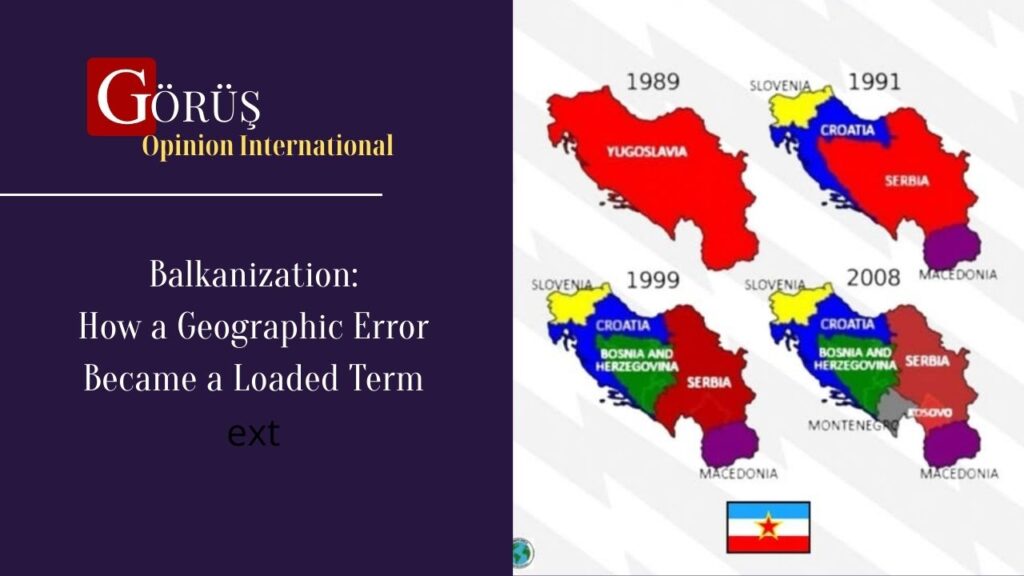
The Imaginary Mountains Behind Balkanization: How a Geographic Error Became a Loaded Term

When we hear the word “balkanization,” we think we know what it means: chaos, fragmentation, violence—the geopolitical equivalent of a shattered windshield. It’s a term that sounds authoritative, almost scientific, yet few people stop to ask where it actually comes from. The answer is more revealing than the definition itself: the entire concept of the “Balkan Peninsula” is based on a geographic mistake made by a German scholar in 1808, and the violent connotations that followed were shaped not by the region’s people, but by the empires that drew their borders.

A Mistake in Berlin

The story begins with Johann August Zeune, a geographer working in Berlin during the Romantic Era. In 1808, Zeune proposed naming the southeastern European landmass the “Balkanhalbinsel” (Balkan Peninsula) in his work Gea: Versuch einer wissenschaftlichen Erdbeschreibung. He believed he had identified a continuous mountain range stretching from the Adriatic Sea to the Black Sea—a geographic spine that would mirror the Apennines running through Italy. There was only one problem: that mountain range doesn’t exist.

Zeune mistakenly assumed that the Balkan Mountains (called Haemus in classical texts) formed this grand continental divide. In reality, modern geologists have determined that the actual Balkan Mountains are only about 600 kilometers long and are confined primarily to Bulgaria. As historian Diana Mishkova notes, Zeune “wrongly believed that the Balkan (Haemus) mountain range was Catena Mundi, crossing the whole peninsula and separating it from the continent.” The name itself—”Balkan”—simply means “mountain” in Turkish, making the designation essentially meaningless: the Mountain Peninsula.

Despite being scientifically debunked, the name stuck. By lumping together Slovenians, Greeks, Bulgarians, Albanians, and Serbs into one geographic container, Zeune created a mental framework that implied unity where none existed. As the term gained currency through the 19th century, it carried with it an expectation that everyone inside this imaginary boundary should somehow act alike.

The Ottoman Mosaic

Before diving into how the Balkans became synonymous with violence, we need to challenge a pervasive myth: that the peoples of this region are inherently prone to conflict. The historical record tells a different story. For over 600 years, the Ottoman Empire ruled this territory with a system that was, in many respects, more tolerant than Western Europe during the same period.

While Catholics and Protestants were slaughtering each other across Western Europe during the 16th and 17th centuries, the Ottoman millet system allowed religious communities to govern themselves with considerable autonomy. Orthodox Christians, Armenian Christians, and Jews were organized into millets—self-administered communities that handled their own legal disputes, collected their own taxes, and ran their own schools. According to historian Peter Sugar, although non-Muslims were second-class citizens compared to Muslims, “the millet system was a highly tolerant system that allowed the Ottomans not only to rule by force but also to incorporate non-Muslims at various levels.”

This is not to romanticize Ottoman rule, but to recognize that stability and coexistence were the norm for centuries. The instability that would define “balkanization” didn’t emerge from ancient hatreds—it emerged from the collapse of this system in the 19th century.

Western Powers and the Rise of Nationalism

As the Ottoman Empire weakened, the great powers of Europe—Britain, France, Russia, and Austro-Hungary—saw an opportunity. They couldn’t simply carve up Ottoman territory without risking war among themselves, so they deployed a different weapon: nationalism. Western intellectuals championed the cause of “oppressed” peoples, encouraging Greeks, Serbs, and Bulgarians to throw off “the Turkish yoke.” Lord Byron wrote poetry glorifying Greek independence; Russia positioned itself as protector of the Slavs.

On paper, self-determination sounds noble. In practice, it was catastrophic. The problem was that the populations in the Balkans were mixed. Serbs lived in Ottoman territory, Greeks lived in Bulgarian areas, Albanians lived everywhere. The millet system had preserved this diversity for centuries by organizing people along religious rather than ethnic lines. But the Western concept of the nation-state demanded ethnic homogeneity: one country, one people, one language.

Between 1804 and 1913, as small nations broke free from Ottoman control, they immediately turned on each other, attempting to “cleanse” their territories to create ethnically pure states. The Western powers that had lit this match then looked at the resulting violence and declared the region inherently barbaric—a prime example of what scholar Edward Said called Orientalism, defining the East as chaotic and violent so the West could position itself as rational and civilized.

Yugoslavia and the Modern Definition

If we want to understand how “balkanization” became shorthand for violent disintegration, we must examine Yugoslavia in the 1990s. For decades, Yugoslavia seemed to defy history—a multi-ethnic federation that actually worked, held together by the leadership of Josip Broz Tito under the motto “brotherhood and unity.” But when Tito died in 1980, the glue dissolved.

The rise of Slobodan Milošević and Serbian nationalism triggered a chain reaction. Slovenia and Croatia declared independence in 1991, followed by Bosnia and Herzegovina in 1992. What followed was not an orderly separation but brutal warfare. The International Criminal Tribunal for the former Yugoslavia later documented campaigns of ethnic cleansing, particularly by Bosnian Serb forces, that resulted in the deaths of over 140,000 people according to the International Center for Transitional Justice. The siege of Sarajevo alone lasted nearly 1,400 days and killed more than 10,000 people, including 1,500 children.

The 1990s Yugoslav wars solidified “balkanization” in the global imagination as synonymous with genocide and ethnic cleansing. Yet as scholar Duško Sekulić points out, this violence was not unique to the Balkans—similar conflicts plagued Northern Ireland, Israel-Palestine, and Rwanda during the same period. The timing of Yugoslavia’s collapse, occurring just as the Cold War ended and many believed liberal democracy had triumphed, made it seem like an aberration rather than part of a broader pattern of nationalist violence.

Ukraine: Reestablishment, Not Fragmentation

The collapse of the Soviet Union in 1991 is often discussed alongside Yugoslavia’s breakup, but there’s a crucial distinction that’s frequently misunderstood—particularly regarding Ukraine. Russian leadership has sometimes suggested that Ukraine is an artificial creation of the Soviet collapse, a narrative that erases centuries of Ukrainian identity.

The historical record contradicts this claim. Ukraine declared independence on August 24, 1991, and held a referendum on December 1. With an 84 percent turnout, over 90 percent of voters—including 55 percent in Russian-speaking Crimea and majorities in every region—endorsed independence. This was not the birth of a new nation but the reestablishment of an old one. Ukraine had briefly achieved independence as the Ukrainian People’s Republic from 1917 to 1921 before being forcibly incorporated into the Soviet Union.

Most significantly, Ukraine possessed a distinct cultural identity that Soviet authorities had actively tried to suppress. Stalin’s man-made famine, the Holodomor of 1932-1933, killed millions of Ukrainians in what many historians recognize as an attempt to crush Ukrainian nationalism. You don’t systematically starve millions to suppress an independence movement that doesn’t exist. The very brutality of the repression proves the existence and persistence of Ukrainian identity.

This distinction matters profoundly. When discussing the Soviet Union’s dissolution, we must differentiate between balkanization—the violent fragmentation of an entity—and restoration—the reemergence of suppressed nations. For Ukrainians in 1991, independence wasn’t chaos; it was liberation.

Conclusion: Whose Map Is Breaking?

The journey from Zeune’s 1808 map to contemporary uses of “balkanization” reveals a troubling pattern. The term describes a real phenomenon—the violent fragmentation of states—but it locates the blame in the wrong place. By treating the Balkans as inherently chaotic, we obscure the role that imperial powers played in creating artificial borders, encouraging nationalist movements, and then abandoning regions to sort out the resulting mess.

Whether in the Balkans, Africa, or the former Soviet Union, fragmentation typically results not from the character flaws of local populations but from the legacy of empires that drew borders with no regard for who actually lived within them. The rip in the map is the symptom, not the disease. The disease is usually the empire that drew the map in the first place.

This matters for how we interpret current events. When we see a region “spiraling into chaos” or a country fragmenting, the crucial questions are not just “Why are they fighting?” but “Who drew these lines?” and “Who benefits when they fall apart?” One person’s balkanization is another person’s independence day. The difference depends entirely on which side of the border—real or imaginary—you’re standing.

Sources

Asceric-Todd, Ines. “The ‘Millet-system’ to the Test: Religious Freedom, Tolerance and Co-existence in Nineteenth-century Ottoman Bosnia.” University of Edinburgh Research Explorer, 2024.

“Balkanization.” Encyclopaedia Britannica, April 29, 2004. https://www.britannica.com/topic/Balkanization

“Breakup of Yugoslavia.” Wikipedia, accessed February 2026. https://en.wikipedia.org/wiki/Breakup_of_Yugoslavia

Çevik, Salim. “From Empire to Nation: Management of Religious Pluralism in the Ottoman Empire and Turkey.” SAGE Journals, 2024.

“Ethnic Cleansing in the Bosnian War.” Wikipedia, accessed February 2026.

Mishkova, Diana. “Balkans / Southeastern Europe.” In European Regions and Boundaries, Berghahn Books, 2017.

Sekulić, Duško. “Everything You Always Wanted to Know about ‘Balkanization’, 2024

Sugar, Peter F. Southeastern Europe under Ottoman Rule, 1354-1804.

“The Conflicts.” International Criminal Tribunal for the former Yugoslavia. https://www.icty.org/en/about/what-former-yugoslavia/conflicts

“Two Hundred Years on the Road: The Term ‘Balkan Peninsula’ (1808-2008).” H-Soz-Kult, August 5, 2008. https://www.hsozkult.de/event/id/event-59990

Tags: Balkan Peninsula originbalkanization meaningbreakup of Yugoslaviaethnic cleansing 1990sgeopolitical fragmentationhistory of balkanizationimperial borders and conflictJohann August Zeunenationalism in the BalkansOttoman millet systemUkraine independence 1991
Önceki

Pir Musa’nın Tanıklığıyla Dersim: Acı, Direnç, Umut…(*)

Sonraki

Türkiye’de Matematik Başarısızlığı: Sayısal Zekâ, Duygusal–Sosyal Faktörler ve Nörobilim Temelli Bir İnceleme

Sonraki
ahlak / nörobilim

Türkiye’de Matematik Başarısızlığı: Sayısal Zekâ, Duygusal–Sosyal Faktörler ve Nörobilim Temelli Bir İnceleme

Kategoriler

  • Dünya
  • Ekonomi
  • Politika
  • Kültür & Sanat
  • Opinion Internatıonal
  • Podcast
  • Gorüş TV
  • Diğer

Sayfalar

  • Anasayfa Yedek
  • Ansayfa
  • Gizlilik Politikası
  • Görüş Hakkında
  • Görüş’te Yazmak | Become an Opinionmaker
  • İletişim | info@gorus21.com
  • Künye
  • Yayın ilkelerimiz
  • Anasayfa Yedek
  • Ansayfa
  • Gizlilik Politikası
  • Görüş Hakkında
  • Görüş’te Yazmak | Become an Opinionmaker
  • İletişim | info@gorus21.com
  • Künye
  • Yayın ilkelerimiz

© 2026 JNews - Premium WordPress news & magazine theme by Jegtheme.

Hoş Geldiniz!

Hesabınıza aşağıdan giriş yapın

Şifrenizi mi unuttunuz? Kayıt Ol

Yeni Hesap Oluşturun!

Kayıt olmak için aşağıdaki formları doldurun

Tüm alanlar zorunludur. Giriş Yap

Retrieve your password

Şifrenizi sıfırlamak için lütfen kullanıcı adınızı veya e-posta adresinizi girin.

Giriş Yap
No Result
Tüm Sonuçları Görüntüle
  • Dünya
  • Ekonomi
  • Politika
  • Kültür & Sanat
  • Opinion Internatıonal
  • Gorüş TV
  • Görüş Podcast
  • Diğer

© 2026 JNews - Premium WordPress news & magazine theme by Jegtheme.