






























Abstract
Mathematics underachievement in Turkey is frequently attributed to insufficient numerical intelligence. However, contemporary research in educational sciences, psychology, and neuroscience suggests that mathematical performance is not determined solely by cognitive capacity, but is also strongly influenced by emotional intelligence, social learning environments, and affective–neural processes. This review examines mathematics underachievement in Turkey through a multidimensional framework, focusing on the neurobiological mechanisms of math anxiety, its long-term psychological consequences, and the ways in which the current education system may reinforce these mechanisms. In addition, the article presents neuroscience-informed and contextually applicable recommendations for the Turkish education system. The findings suggest that sustainable improvement in mathematics achievement requires not only curricular reform but also learning environments aligned with how the brain learns under conditions of stress, motivation, and social interaction.
Keywords: Math anxiety, numerical intelligence, emotional intelligence, neuroscience, Turkish education system
1. Introduction
Mathematics plays a central role in academic achievement, problem-solving ability, and long-term educational and occupational trajectories. Despite its importance, mathematics performance has remained a persistent challenge in Turkey, attracting sustained attention from policymakers and researchers. Public discourse often explains this challenge by referencing students’ lack of numerical intelligence or innate ability. However, such explanations overlook the complex cognitive, emotional, and social processes involved in learning mathematics.
Growing evidence from psychology and neuroscience indicates that mathematics learning is highly sensitive to emotional states, particularly anxiety, as well as to the quality of social and instructional contexts. This review aims to synthesize findings from these fields to provide a comprehensive account of mathematics underachievement in Turkey, emphasizing the role of math anxiety, neural mechanisms, and long-term psychological outcomes.
2. Numerical Intelligence and Mathematical Learning
Numerical intelligence refers to the ability to reason quantitatively, understand numerical relationships, and solve abstract problems. Contemporary theories of intelligence emphasize that numerical ability is not a fixed trait but a malleable capacity shaped by learning experiences, instructional design, and affective factors.
Mathematical problem solving places substantial demands on working memory, requiring learners to hold and manipulate information simultaneously. When emotional stress is introduced, particularly anxiety, working memory resources are compromised, resulting in reduced performance even among students with adequate conceptual knowledge.
3. Emotional and Social Factors: The Role of Math Anxiety
Math anxiety is defined as a negative emotional response characterized by tension, fear, and avoidance behaviors in mathematical contexts. Extensive research demonstrates that high levels of math anxiety are associated with lower mathematics achievement, largely due to interference with working memory and attentional control (Ashcraft & Kirk, 2001).
Social factors within classrooms further contribute to the development of math anxiety. Learning environments in which errors are stigmatized, questioning is discouraged, or performance is publicly compared tend to amplify anxiety. In exam-oriented systems, such as that of Turkey, repeated exposure to high-stakes assessments may reinforce avoidance behaviors and negative self-perceptions related to mathematics.
4. Neuroscientific Evidence on Math Anxiety
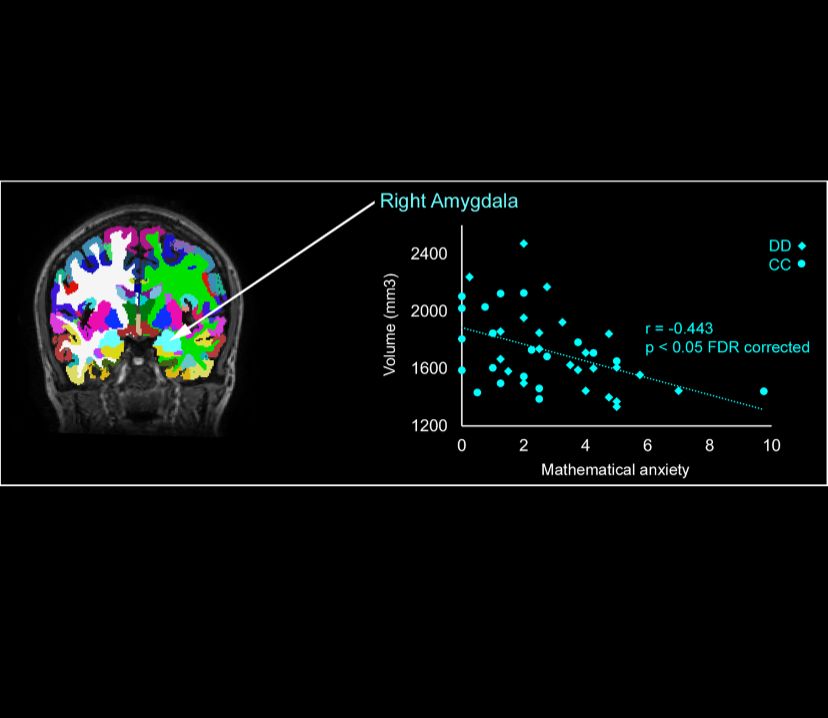
Neuroimaging studies provide insight into the mechanisms through which math anxiety impairs performance. Elevated math anxiety has been associated with increased activation in brain regions involved in threat detection and emotional processing, particularly the amygdala. At the same time, reduced activation is observed in regions responsible for executive control and mathematical reasoning, including the prefrontal and parietal cortices.
Importantly, some studies show that neural responses associated with math anxiety can be triggered even before mathematical problem solving begins, during anticipation of mathematical tasks. This anticipatory response contributes to avoidance and cognitive disengagement.
Crucially, the brain’s plasticity allows these patterns to change. Interventions such as structured tutoring and supportive instructional practices have been shown to reduce math anxiety and normalize neural activity in circuits related to numerical processing (Supekar et al., 2015).
5. Long-Term Psychological Consequences
Persistent difficulties in mathematics can produce effects that extend far beyond academic performance. Repeated failure experiences may foster learned helplessness, characterized by the belief that effort will not lead to improvement. Over time, this belief can generalize to other academic domains and reduce overall motivation.
Students with chronic math underachievement are more likely to report low academic self-concept, heightened anxiety, and avoidance of STEM-related fields. These long-term outcomes not only affect individual well-being but also have broader implications for workforce development and social equity.
6. Turkey in an International Context
International assessments conducted by the OECD, such as PISA, indicate that Turkey’s mathematics performance remains below the OECD average, though recent cycles suggest gradual improvement. Cross-national comparisons reveal that high-performing systems tend to emphasize conceptual understanding, collaborative learning, and formative assessment rather than exclusive reliance on high-stakes testing.
These findings suggest that Turkey’s challenges in mathematics achievement are not inevitable but are responsive to systemic and pedagogical change.
7. Neuroscience-Informed Recommendations for the Turkish Education System
7.1 Classroom-Level Interventions
• Adoption of low-stakes formative assessments to reduce threat perception
• Process-oriented feedback emphasizing reasoning rather than correctness
• Instructional designs that manage cognitive load and support working memory
7.2 School-Level Interventions
• Early screening for math anxiety and low self-efficacy
• Small-group or individualized mathematics support programs
• Professional development for teachers on math anxiety and brain-based learning
7.3 System-Level Reforms
• Balancing high-stakes examinations with process-based evaluation
• Curriculum revisions prioritizing depth over content density
• Targeted resource allocation for socioeconomically disadvantaged regions
8. Discussion
This review highlights that mathematics underachievement in Turkey cannot be adequately explained by deficits in numerical intelligence alone. Emotional regulation, social learning contexts, and neural mechanisms play critical roles in shaping mathematical performance. Educational practices misaligned with these processes risk reinforcing anxiety and disengagement.
Aligning instruction with neuroscientific insights offers a promising pathway for improving both achievement and psychological well-being.
9. Conclusion
Mathematics underachievement in Turkey is a multidimensional and systemic issue. Addressing it requires moving beyond ability-based explanations toward an educational approach informed by emotional, social, and neuroscientific evidence. By creating learning environments that reduce anxiety and support cognitive functioning, sustainable improvements in mathematics education are achievable.
Ethical Statement
This article is a review study and does not involve human participants; therefore, ethical approval was not required.
Author Contributions
The author was responsible for the conceptualization, writing, and revision of the manuscript.
Funding
No financial support was received for this study.
Conflict of Interest
The author declares no conflict of interest.
References (APA 7)
Ashcraft, M. H., & Kirk, E. P. (2001). The relationships among working memory, math anxiety, and performance. Journal of Experimental Psychology: General, 130(2), 224–237.
Bandura, A. (1997). Self-efficacy: The exercise of control. New York, NY: Freeman.
Ramirez, G., Gunderson, E. A., Levine, S. C., & Beilock, S. L. (2013). Math anxiety, working memory, and math achievement. Psychological Science, 24(9), 1619–1628.
Supekar, K., et al. (2015). Remediation of childhood math anxiety and associated neural circuits through cognitive tutoring. Journal of Neuroscience, 35(36), 12574–12583.
OECD. (2023). PISA 2022 results. Paris: OECD Publishing.